Your Opinion About AI — Is It Actually Yours?


A rushing river.
New AI models every week. Terminology that multiplies faster than anyone can track. Headlines swinging from alarm to euphoria and back, sometimes within the same news cycle. And on each bank, people shouting: about jobs lost, about cancer cured, about democracy threatened, about productivity unlocked. The voices are loud and certain, trying to pull the rest of us to their side.
Many people do the rational thing. They pick one riverbank and climb out.
And I understand it. Staying in the current takes work. There are sensible reasons to love this technology and sensible reasons to distrust it. But opting out entirely is becoming harder to do. AI is showing up in everyday life whether we invite it or not. Which is exactly why a thoughtful perspective matters more than a clean verdict.
But there's a quieter option than either bank — an eddy, that pocket of calmer water where the river still reaches you but doesn't decide for you. That's where I want to spend our time today. And I invite you to join me there.
Many companies already live in the contradiction
Here's something I find genuinely interesting. In my S&P 1500 dataset — 6,066 annual filings from large-, mid-, and small-cap U.S. companies — a rising share of companies formally document AI as both an opportunity and a risk in the same filing. Not in separate years. The same document.
It's still a minority. But it's a fast-growing one. In FY2022, fewer than 4% of AI-active filers held both framings simultaneously. By FY2025, that share had nearly tripled — and among the largest S&P 500 companies, it's approaching one in seven.
Think about that a second. These are serious organizations with lawyers, accountants, and boards. They are not confused. They are being precise. The large-caps are leading (they have more legal scrutiny and more sophisticated disclosure practices), but the mid- and small-caps are following the same arc.
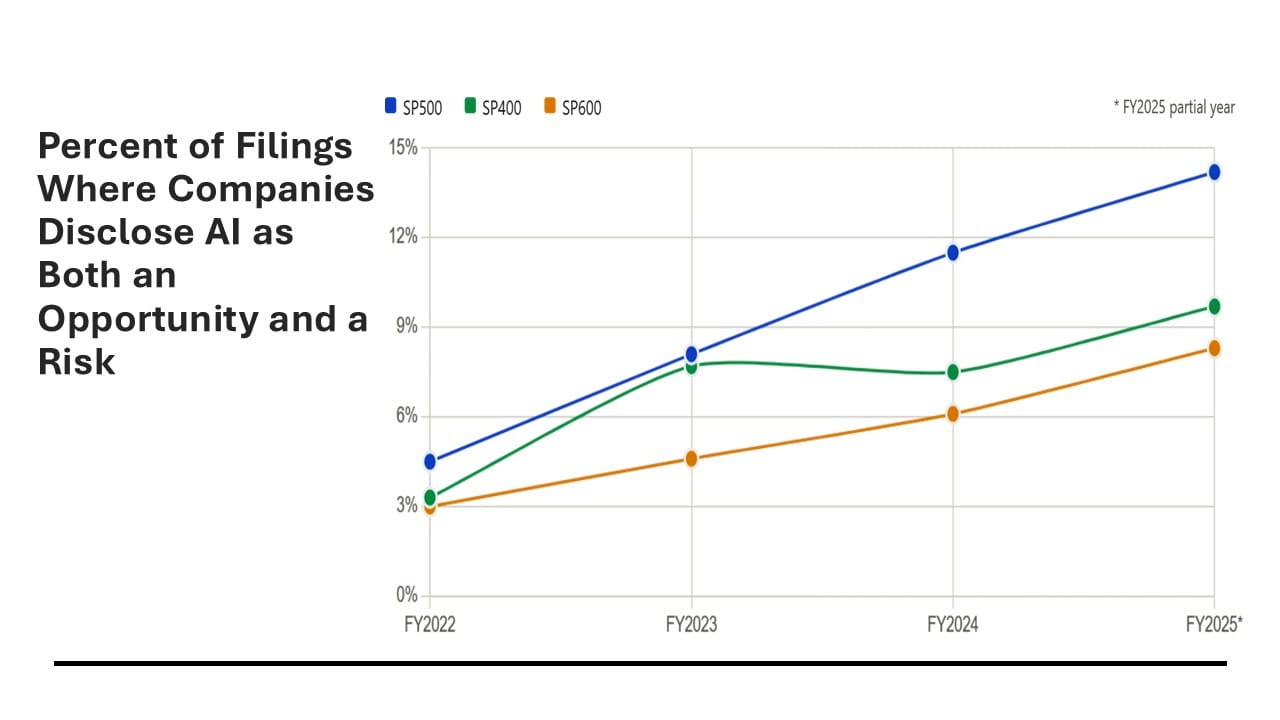
That's not hedging. That's what sophisticated decision-making actually looks like: acknowledging both, conflicting possibilities. The question worth asking is why our public conversation can't do the same.
Strong reactions are human. And we've seen them before.
As far back as 2,500 years ago, Socrates was worried about a new technology: writing itself. He had a real concern: writing things down would prevent people from building memory. Plus, he worried that writing would allow people to imagine they understood something when they had merely encountered it. To seem wise rather than be wise. He never wrote a word himself; everything we know about his views exists only because his student Plato DID write them down.
Socrates was right, by the way. We did trade written documentation for superior memory. We just decided the trade was worth it.
When the Luddites destroyed textile machinery in early 19th century England, they became symbols of irrational technophobia. That's not what they were. They were skilled weavers who could see exactly who was going to benefit from industrialization and who was going to suffer. They weren't wrong about the distribution of harm. They just aimed their objections at the machines instead of the men who owned them. Years later, the railroad barons attracted the same rage, for the same reason — extraordinary technology, dangerous power concentration, both true at once.
The pattern is consistent enough to be useful: The panic is rarely just about new technology itself. It's a proxy for existing concerns about power, control, displacement, and identity — suddenly made more visible by the technology.
AI is not an exception to this pattern. It is the latest instance of it.
And then there's Fei-Fei Li
In the early 2000s, a computer scientist named Fei-Fei Li became curious about whether a machine could learn to recognize images the way humans do. Not to build a surveillance apparatus. Not to corner a market. She was curious about a hard problem, and she wanted to know if it could be solved.
The work that followed helped ignite the modern AI era. The image recognition that now underlies medical diagnostics also underlies facial recognition systems that governments use in ways she did not intend and does not endorse. She pulled a thread. The people who wove it into a net are different actors, with different intentions.
Curiosity is how knowledge advances. What happens to that knowledge afterward is a governance question, not a scientific one. Conflating the two is how we end up shouting at the wrong target.
What the noise is actually doing
A combination of factors is discouraging thoughtful dialog.
Specialized language — RAG, MCP, agentic, LLM, fine-tuning — unites insiders while excluding those on the outside. This is not unique to AI. Lawyers do it. Doctors do it. Financiers do it. Jargon is a power structure as much as a vocabulary, and when you can't grasp the terminology, the conversation happens without you.
The pace of change compounds this. Hallucination headlines from 2023 are still shaping people's mental models in 2026, even as the models have improved substantially. Some of us may be afraid of a version of this technology that no longer exists.
And polarization finishes the job. When the discourse sorts us into two camps — salvation or catastrophe — it gives people a team to join instead of an informed position to develop. Allegiance is much easier than curiosity. It also requires much less of you.
But remember, the loudest voices on both sides have a strong interest in where you land.
The only question worth asking
I am not suggesting everyone must become a technologist. You don't need to know what RAG or MCP stand for to have a useful view on AI.
What I am suggesting is both smaller and harder at the same time. That you ask yourself: Do I understand AI well enough that I can form my own opinion about it?
If you're worried about AI executives buying political influence (and there are reasons to be) it's worth asking whether someone is also buying yours. Not through lobbying. Through the headlines you consume, the voices you amplify, the riverbank you climbed on when the current got fast.
Curiosity is how you stay in the current. Rather than picking one of the noisy sides, you form your own position — and keep forming it, as things change, because they will keep changing.
The river isn't going to slow down or go away. Climbing out is always an option. Or you can look for some calmer water, stay in it, and decide for yourself what this all means.