Finding Answers in Between


My favorite color is teal.
Not blue. Not green. Teal — a color that can't make up its mind.
I mention this because it tells you a lot about how I see the world. I rarely find insight at the extremes. It's usually hiding in the places most people overlook as they jump to a cleaner conclusion. A blue or green one.
Most AI stories prefer extremes. They attract attention. But real-world AI lives in the middle.
One camp will tell you it's coming for your job, your privacy, your kids, and possibly your soul. The other will tell you it's about to cure cancer, end drudgery, and finally deliver the four-day week. Both camps are loud. Both are certain. And here's the catch: neither one helps you decide what to do on Monday morning.
That's the problem with picking a side. It ends the conversation exactly where it should begin.
So before we argue about whether AI is salvation or catastrophe, let me put one thing on the table that actually isn't in dispute.
It's here.
It's here — virtually everywhere
I spent the last few months extracting what companies say about AI. Not pundits. Not vendors with something to sell. The companies themselves, in the one document where saying too much carries real legal risk: the annual 10-K.
(With AI's help) I built a dataset from 6,066 of those filings across the S&P 1500 — roughly 1,500 large-, mid-, and small-cap U.S. companies, fiscal years 2022 through 2025. (I am a recovering statistician, so "I reviewed 6,066 annual reports for fun" is something I can say with a smile.)
In FY2022, one in four of those companies mentioned AI at all. By FY2025, it was nine in ten.
Think about that a second. In three years, we went from "not many" to "virtually everyone."
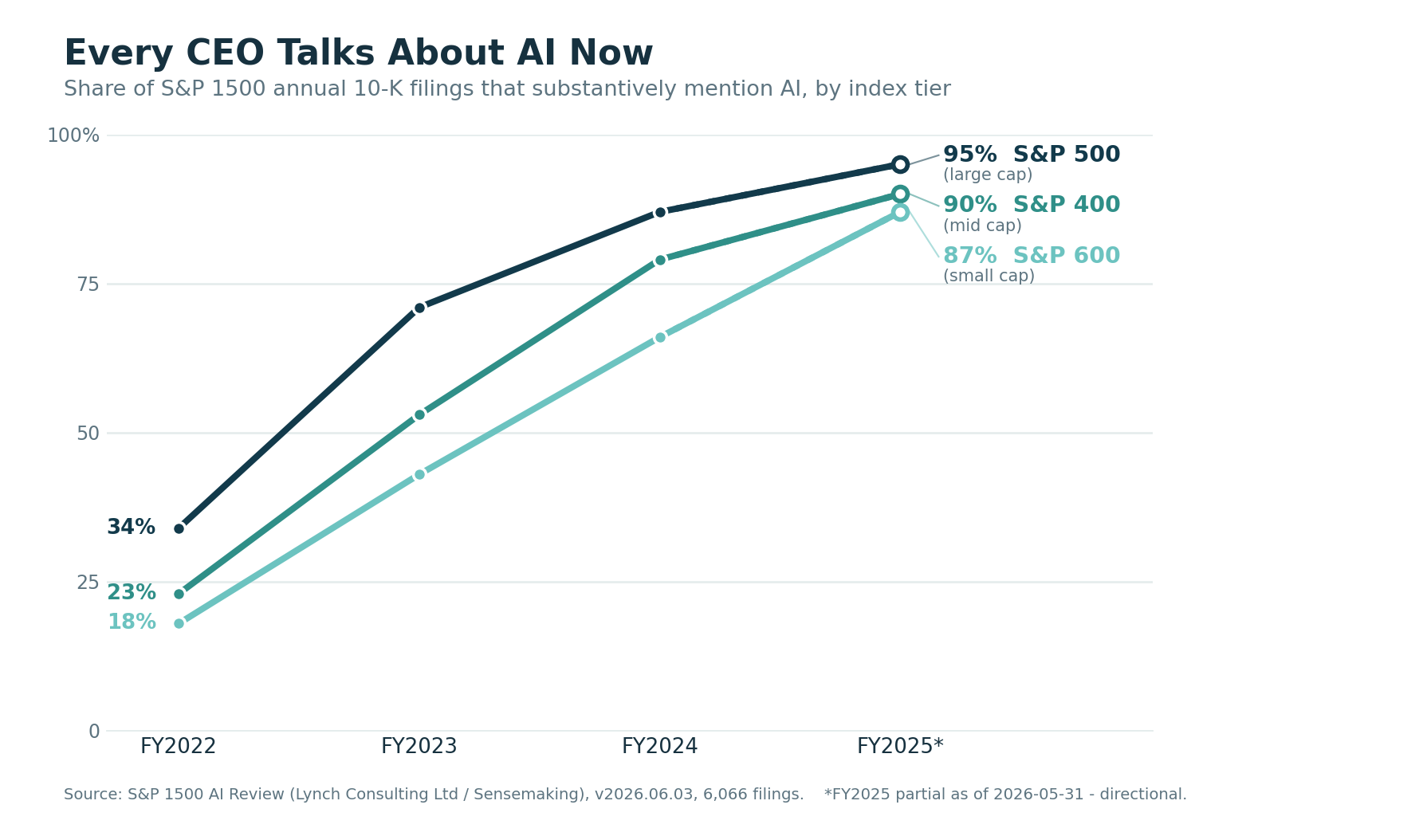
The tech giants led the way, of course. The large-cap S&P 500 went from 34% to 95%. But look at the bottom line on that chart — the small-cap S&P 600, the cement makers and regional utilities and mid-market manufacturers. They started at 18%. They finished at 87%.
In 2022, a big-cap company was nearly twice as likely to mention AI as a small-cap one — 34% against 18%. Three years later, that 16-point gap had closed to 8. The laggards didn't just join the conversation — they nearly caught up to the front of it.
So what? It means AI has stopped being a Silicon Valley story and become an every-boardroom-everywhere story. If you've been waiting for the AI conversation to reach your industry before you formed a view, the wait is over. It's already in your competitors' annual report. The question is no longer whether this touches your work. It's how well you respond to it.
Why "good or bad?" is the wrong question
Here's the twist. Knowing AI is everywhere tells you nothing about whether it's helping.
A company that fills its 10-K with confident AI language might be transforming itself — or it might be telling shareholders a good story. A company that says nothing might simply be behind — or quietly running the most disciplined deployment in its sector. Adoption of language is not adoption of value. I'll spend a lot of this newsletter on that gap, because it's what separates the companies that apply AI meaningfully from the ones that just talk about it
And that's exactly why the salvation-vs-catastrophe argument is a dead end. If you decide AI is only dangerous, you'll miss the places it genuinely creates value and let competitors find them first. If you decide it only beneficial, you'll minimize the failures, the hallucinations, and the quiet erosion of judgment.
While a verdict may feel like progress, it's actually an excuse to stop paying attention.
The useful posture isn't optimism or pessimism. It's both, held at the same time, applied to a specific decision in front of you.
Why this newsletter? Why now?
It feels like a rational middle is missing from AI discussions.
Somewhere off to the side of all this, there's a quieter conversation waiting to happen — about what's real, what's overblown, and what you might actually do about either. I invite you to join me there.
That's my hope. Not to tell you AI is all good. Not to warn you it's all bad. But to examine all sides. To translate — between the people building these systems and the people who have to make decisions about them, two groups that increasingly cannot understand each other. It's a continuation of my work as an Analytic Translator.
Every issue, I'll take one thing happening at the intersection of business and technology and ask the question that matters: what does this actually mean for what you do next? Sometimes that means helping an executive cut through the layers of jargon obscuring what AI can actually do. Sometimes it means showing a brilliant data team how their model doesn't fit the business reality.
It will not be hype. It will not be doom. It will be teal.
Welcome to Sensemaking — a place willing to sit in the messy middle, where the answers usually are.
Wendy Lynch, PhD · Lynch Consulting Ltd. The figures above come from the S&P 1500 AI Review (v2026.06.03); a fuller methodology is available for anyone who wants to see how the sausage is made. I know I usually do.